Electrical Certificate of Compliance (CoC) in South Africa: 2026 Cost Guide & Inspection Checklist
By Local Crew Editorial Team · 6 October 2026
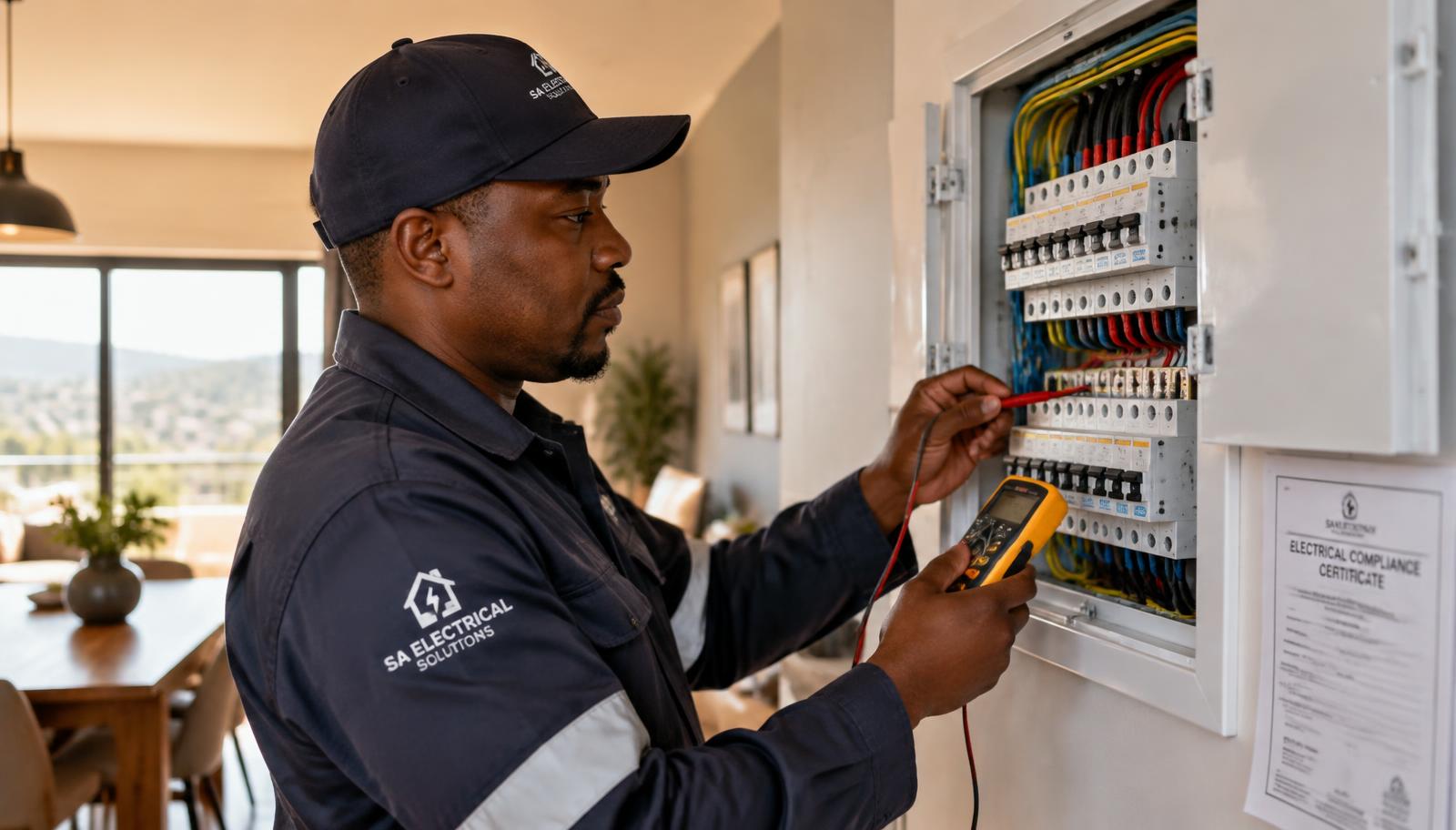
If you are selling a property, installing solar or a backup inverter, or settling an insurance claim in 2026, you will need a valid Electrical Certificate of Compliance (CoC). The certificate is not a formality: it is a legal declaration, signed by a registered person, that the fixed electrical installation on the property complies with SANS 10142-1, the South African wiring code enforced under the Occupational Health and Safety Act (OHSA).
The most common question homeowners ask is what the certificate actually costs. The short answer for 2026: expect R1,200 to R2,500 for the inspection and certificate itself in most metros, more for large or older properties, and extra if repairs are needed to bring the installation up to standard. This guide breaks down those costs, explains exactly what an inspector checks, lists the failures we see most often in South African homes, and answers the questions sellers ask most.
Table of Contents
- What an Electrical CoC is and why SANS 10142-1 matters
- Electrical CoC inspection fees by property type (2026)
- Inspection fee vs. remedial repairs: what you are actually paying for
- When a CoC is legally required
- How long a CoC stays valid
- The 2026 inspection checklist: what the electrician tests
- The most common failure reasons in South African homes
- Who is authorised to issue a CoC
- Frequently asked questions
What an Electrical CoC is and why SANS 10142-1 matters
An Electrical Certificate of Compliance is a legal document, in the format prescribed by the Electrical Installation Regulations of 2009 (under OHSA), that confirms a property's fixed wiring, distribution board, earthing and bonding comply with SANS 10142-1: The Wiring of Premises. Only a person registered with the Department of Employment and Labour (DoEL) as an Electrical Inspector or Electrician may sign and issue one.
The certificate covers the fixed electrical installation: the supply cable, mains switch and metering, distribution board, circuit wiring, earthing system, and permanently connected equipment such as geysers, stoves, and pool pumps. It does not cover freestanding plug-in appliances.
Why the legal weight matters: a CoC is not a inspection report you can argue with later. If a fire or shock incident is traced to non-compliant wiring and you cannot produce a valid CoC for the work, insurers can repudiate the claim and sellers can face civil claims from buyers. Conveyancing attorneys will not register a transfer without one.
Electrical CoC inspection fees by property type (2026)
Fees vary by city, property size, the age of the installation and how many sub-boards or outbuildings must be tested. The ranges below reflect typical 2026 pricing in Gauteng, the Western Cape and KwaZulu-Natal:
- Apartment / flat (1–2 bedrooms): R1,100 to R1,600. Simple single-phase installation, usually one distribution board and no outbuildings.
- Freestanding house (3+ bedrooms): R1,500 to R2,500. More circuits, often a geyser, pool pump, garden lights and sometimes a cottage or flatlet with its own board.
- Large home, estate property or smallholding: R2,800 to R4,500+. Multiple distribution boards, three-phase supply, solar or inverter systems, borehole pumps and outbuildings all add testing time.
Three things most often push a quote above the base range: additional distribution boards (each adds roughly R350 to R600), solar, inverter or battery installations (which require a separate Certificate of Compliance for the renewable installation and additional testing time), and distance: some contractors charge a call-out fee of R300 to R650 for properties far from their base.
Get free Electrical CoC quotes
Tell us about your property and where it is. Registered electricians on Local Crew will quote you for the inspection, certificate and any remedial work, with no obligation and no cost to request quotes.
Request free electrical quotesInspection fee vs. remedial repairs: what you are actually paying for
The fee quoted for a CoC buys you two things: the testing and inspection of the installation against SANS 10142-1, and the issue of the certificate if the installation passes. It does not include repairs. This distinction catches many sellers out, so it is worth being precise.
If the electrician finds non-compliant work, they will give you a defect list or quotation for remedial work before issuing the certificate. Common repairs in 2026 South African homes and their typical costs:
- Earthing or bonding corrections (e.g. unbonded geyser or metal window frames): R450 to R1,200.
- Replacement of a non-SANS approved or overloaded distribution board: R3,500 to R8,000 depending on circuits.
- Replacing incorrect circuit breakers or adding earth leakage protection: R850 to R2,500.
- Re-wiring damaged circuits, roof-cavity or garden wiring: R1,500 to R6,000+ depending on access and length.
- Adding isolators for fixed appliances (stove, geyser, pool pump): R350 to R900 each.
A reputable contractor will never issue a CoC for an installation that still has defects: doing so is a criminal offence under the Electrical Installation Regulations and voids their registration. If someone offers you a "guaranteed pass, no inspection" for a suspiciously low fee, walk away: the certificate is worthless and the liability is yours.
When a CoC is legally required
You need a valid Electrical Certificate of Compliance in the following situations:
- Property sales and transfers: The seller must provide a valid CoC to the buyer before the transfer can be registered. This is a statutory obligation under the Electrical Installation Regulations, and conveyancers will not finalise without it.
- New solar, inverter and battery installations: Any change to the installation, including adding alternative power supply, legally requires a new or updated CoC for the altered part of the system.
- Major renovations or additions: New circuits, a new distribution board, an electric fence, garden lighting or an outbuilding all require the altered work to be certified.
- Insurance claims and policy requirements: Insurers increasingly demand proof of a valid CoC after electrical fires, surge damage claims, or when underwriting older properties and homes with solar.
- Change of use or tenancy: Landlords converting a home into student accommodation or multiple dwellings should re-certify, as the intensity of use changes the risk profile.
How long a CoC stays valid
For property transfers, the rule that matters is this: the CoC must reflect the installation at the time of sale, and the accepted industry standard is that a certificate is valid for two years from the date of issue, provided no alterations have been made in that period. If you had a CoC issued three years ago, or if any electrical work has been done since, a fresh inspection is required.
Two practical notes: first, a CoC is a snapshot, not a licence. If you add a geyser, air conditioner or inverter after the certificate was issued, the installation has altered and the certificate no longer covers it. Second, keep the certificate safe: you will need the original (or a certified copy) at transfer, and your insurer may ask for it years later.
The 2026 inspection checklist: what the electrician tests
A SANS 10142-1 inspection is a systematic test of the whole fixed installation, not a quick visual glance. Expect the electrician to spend one to three hours on site for a typical house. Here is what is checked, grouped by area:
Distribution board (DB board)
- Correct labelling of all circuits and a clear, accessible board with no exposed live parts.
- Approved circuit breakers rated correctly for the cable size on each circuit.
- Functional earth leakage protection (RCD) on socket and lighting circuits, tested by injecting a fault current.
- Tight, correct terminations with no doubled-up conductors, no overheating marks and no non-approved brands.
- Separation of supply for any solar, inverter or generator changeover equipment.
Earthing and bonding
- A continuous earth conductor from the board to an earth electrode, with resistance measured and recorded.
- Bonding of all metalwork: geyser, stove, metal window frames, metal water pipes, antenna masts and pool structures connected to the earthing system.
- Correct earth conductor sizes for the supply type (TN-S, TN-C-S or TT systems common in South Africa).
Light fittings, isolators and fixed appliances
- All light fittings, switches and sockets are approved, securely mounted and correctly wired.
- Isolators fitted for every fixed appliance: stove, geyser, pool pump, air conditioner and borehole pump each need a means of local isolation.
- Polarity and continuity testing on every socket outlet and lighting point.
- Insulation resistance testing on the wiring, particularly in older properties where cable insulation may have degraded.
The most common failure reasons in South African homes
Based on what electricians on Local Crew report from thousands of inspections, these are the defects most likely to stop your certificate in 2026:
- Unbonded geysers: The single most common failure. A geyser without bonding to the earthing system is a serious shock risk and an instant defect.
- Roof cavity wiring hazards: Downlight transformers joined with twist-on connectors, cables resting on ceiling insulation, or unclipped wiring in the roof space.
- Missing isolators: Fixed appliances, especially stoves and pool pumps, without a local isolation switch.
- Non-approved or counterfeit breakers in the distribution board, or breakers mismatched to cable size.
- No earth leakage protection on older boards, or an earth leakage unit that fails the trip-time test.
- DIY additions: Garden cottages, air conditioners and plug circuits added by handymen without certificates, often with undersized or damaged cable.
- Corroded or missing earth electrodes, particularly in coastal properties.
The pattern behind most of these is the same: work was done cheaply or by someone unregistered, and nobody re-certified. The lesson for sellers is to budget for a pre-sale electrical check early, not in the last week before transfer.
Who is authorised to issue a CoC
Not every electrician can issue a Certificate of Compliance. The person signing must be registered with the Department of Employment and Labour (DoEL) as an Electrical Installer (also referred to as holding a Wireman's Licence), in the appropriate category for the work. Registered installers are also typically affiliated to an industry association such as ECA(SA) (Electrical Contractors' Association of South Africa) or the NBCEI (National Bargaining Council for the Electrical Industry), which provide additional vetting and dispute channels.
How to protect yourself: ask for the electrician's DoEL registration number before the inspection, and verify that the certificate you receive is an original with that number, a serial number, and the contractor's details. Every Pro in the electrical category on Local Crew is vetted before joining, so you can request quotes knowing registration has been checked.
Frequently asked questions
Who pays for the Electrical CoC when selling a property?
The seller pays. Providing a valid CoC is the seller's statutory obligation, and the cost of the inspection and any remedial work needed to pass is normally the seller's expense. The buyer's only involvement is receiving the original certificate at transfer. Some sale agreements allocate repair costs differently, so check your offer to purchase.
What if the electrician refuses to issue the CoC?
The electrician must issue a defect list explaining exactly what fails and why, quoted separately for the repairs. You are entitled to have those repairs done by any registered installer, not only the one who did the inspection. Once the defects are corrected, a re-inspection follows (sometimes at a reduced re-visit fee) and the certificate is issued. If you believe a refusal is unreasonable, you can request a second opinion from another registered installer, or escalate a dispute through their association such as ECA(SA).
Do plug-in appliances count towards the CoC?
No. The certificate covers the fixed electrical installation only: wiring, the distribution board, earthing, and equipment permanently connected to the installation (including appliances on dedicated circuits with isolators, such as stoves, geysers and pool pumps). Freestanding plug-in appliances like fridges, kettles and televisions are not part of the inspection.
How long does the inspection take?
Between one and three hours for a typical home: an apartment can be done in under an hour, a family home with a geyser, pool and outbuildings usually takes two hours, and large properties with multiple boards, solar or three-phase supply can take most of a morning. Add time for the paperwork: the certificate is usually issued the same day once the installation passes.
Is a separate CoC needed for solar and inverter systems?
Yes. A solar PV, inverter or battery installation alters the fixed installation, so it requires its own Certificate of Compliance issued by a registered installer competent in alternative-supply work, in addition to the certificate for the rest of the installation. Sellers of homes with solar should budget for both.
The bottom line
In 2026, budget R1,200 to R2,500 for the inspection and certificate on a typical home, more for large or complex properties, and keep a contingency for remedial work, since unbonded geysers and roof-cavity wiring alone fail a large share of first inspections. Book the inspection as soon as you know you are selling, not in the final week of transfer, and use a DoEL-registered electrician whose number appears on the certificate.
Find a registered electrician near you
Local Crew connects you with vetted, DoEL-registered electricians across South Africa for CoC inspections, remedial work and solar certification. Requesting quotes is free for homeowners.
Request free electrical quotes